


Country: France (Provence-alps-cote d’Azur), Italy (Piedmont/Sardinia)
Type of reality: Project of APPAM (Association pour la Promotion du Pastoralisme dans les Alpes Maritimes)
Target audience: B2C, B2C
Website: tapisbrigasques.weebly.com
Scenario
Upland livestock farming has been facing a decline for years now, both in terms of the number of livestock and the number of farms (Zucaro et al ., 2019) due to theeconomic and social unsustainability of the livestock farming condition. Therefore, the production of meat and dairy products is outsourced to intensive livestock farms , which in addition to centralizing the market and mistreating livestock, globally affects the production of anthropogenic greenhouse gases by about 24 percent (Pigeon, 2023). The consequence of the abandonment of extensive livestock farming practices in the mountains is environmental degradation:“From the pastoral point of view, it is clear that, in an era in which the forest is regaining much of the abandoned agricultural areas, the maintenance of meadows and pastures also satisfies naturalistic objectives, allowing the permanence of meadow or ecotonal habitats of particular value” (Bovolenta et al ., 2008). Therefore, the biodiversity of animal and plant species that survive through the pasture agroecosystem is in serious danger. On the other hand, the few who endure in sheep farming are forced to treat wool as waste because the cost of shearing is higher than the selling price of wool: ” Each sheep produces, roughly, one and a half kilograms of wool, which is placed on the market at 10 cents per kilo. Considering that to shear it, farmers call professionals from abroad who demand a price of 1.45 euros per sheep, the farmer is in a loss-making condition ” (Baraldi, 2024).
Description
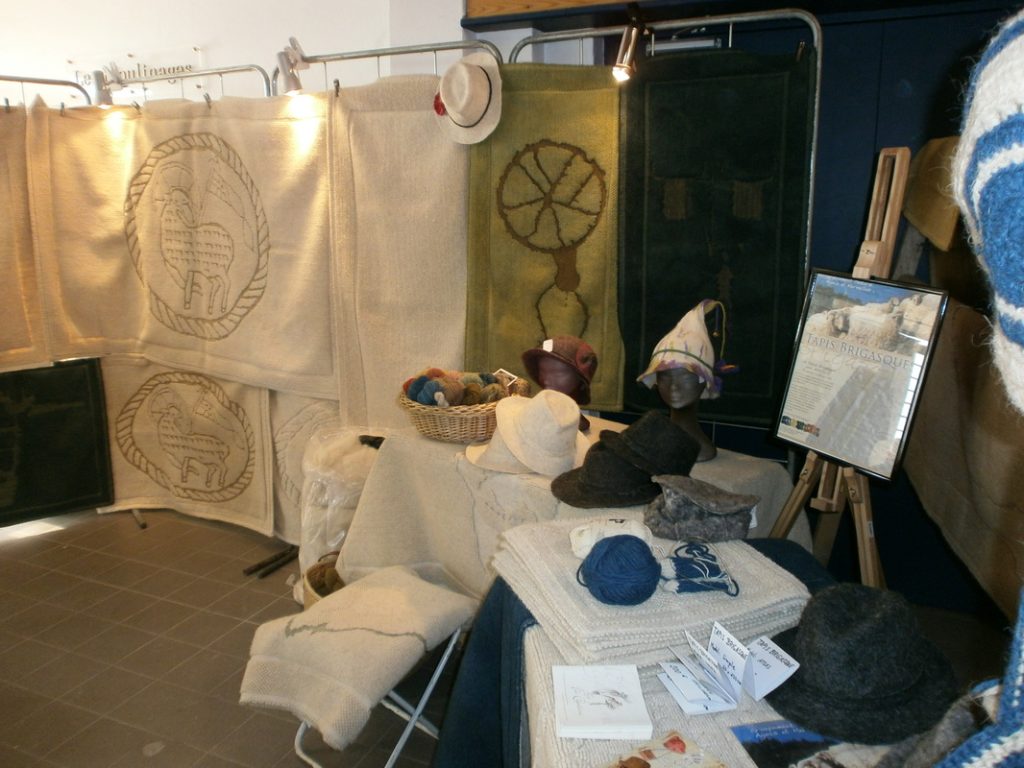
Tapis Brigasques is a project of APPAM (Association pour la Promotion du Pastoralisme dans les Alpes Maritimes), an association founded in 2001 to protect livestock farmers in the Maritime Alps area. Le Brigue is a commune in the Maritime Alps of the Roya Valley in the Provence-Alpes-Côte d’Azur department. Within the area of this commune, breedingof the Brigue sheep, an indigenous breed, is widespread. In 2009, APPAM created the Tapis Brigasque project with the idea of valorizing its wool. This is a by-product of animal husbandry that is generally discarded. Through collaboration with theSardinian textile company Crabulu, based in Nule in the province of Sassari, French and Piedmontese Brigasque sheep farmers joined forces so that they could resell their wool at a fair price. The wool after being collected from the farms is shipped to Nule to be processed and made into rugs, these are then shipped back and resold locally or through other retailers. This process generates a virtuous circle in which the gainers are the herders who can enjoy in advance the earnings associated with the sale of the rugs and, being able to count on more income, can continue their pastoral activities, thus keeping thealpine ecosystem unaffected and biodiversity safe.
Bibliography
- Baraldi, M. (2023). Italian sheep wool: from a waste to a resource. Mapping Italian realities and projects for upgrading discarded wool and establishing a new supply chain (Doctoral dissertation, Polytechnic University of Turin).
- Bovolenta, S., Pasut, D., & Dovier, S. (2008). Breeding in the mountains: traditional systems and current trends. SoZooAlp journals, 5, 22-29.
- Pigeon, S. (2023). The strategic role of the European Union in reducing emissions from intensive livestock farming: the Common Agricultural Policy as a regulatory tool for the livestock sector.
- Zucaro, M., Genovese, D., & Battaglini, L. (2019). Perception of ecosystem services of mountain livestock farming: a survey in the Susa Valley (Turin). In ECOSYSTEMIC SERVICES growth opportunities for mountain farming? (Vol. 10, pp. 37-47). SoZooAlp-Soc. for the study and valorization of alpine sist. alpine animal husbandry.


