Fact sheet written by Elena Gullino, Lucia Hendel, Mokhathi Maleballo from the Gastronomic Design Sciences course of the UNISG Bachelor of Science in Gastronomic Sciences and Cultures.
Country: Italy
Address: Loc. Fornaci, Castiglione del Lago, 06061 (PR) Italy
Type of entity: Association of Social Promotion (APS)
Target audience: B2B; B2C
Web site: www.seccobio.it
Scenario
In Italy, food waste is a significant problem, especially in local markets, where large quantities of fresh produce go unsold every day. Vendors bring in crates of fruits and vegetables that are perfectly edible but have small defects in size, shape, or color. Because of consumers’ expectations of visually perfect products, many of these foods go unsold and are thrown away at the end of the day.
Despite efforts to promote sustainable consumption, a large amount of waste is caused by unrealistic aesthetic standards. These products, while nutritionally sound, could be reused or processed to extend their shelf life. However, logistical problems and poor infrastructure for redistribution mean that much of the surplus is discarded instead of being donated to charities or food banks.
In recent years, a number of NGOs and social enterprises have begun to take action, recovering excess food from markets and turning it into dried or canned products, thus reducing waste. These initiatives show that, with the right investment and increased public awareness, Italy can address food waste more effectively, while supporting local producers and communities.
Description
The Secco Bio project, based in Castiglione del Lago, Umbria, was launched in 2020 by Davide Sangiovanni, an agronomist with a degree from the University of Perugia. Based on a philosophy of sustainability and circular economy, Secco Bio addresses agricultural waste by recovering organic surplus from small local farms. During periods of intensive harvesting, farmers often find themselves with overproduction not absorbed by the market. This is where Secco Bio steps in: through direct harvesting in the fields or salvaging unsold vegetables, Davide brings them to his own certified laboratory.
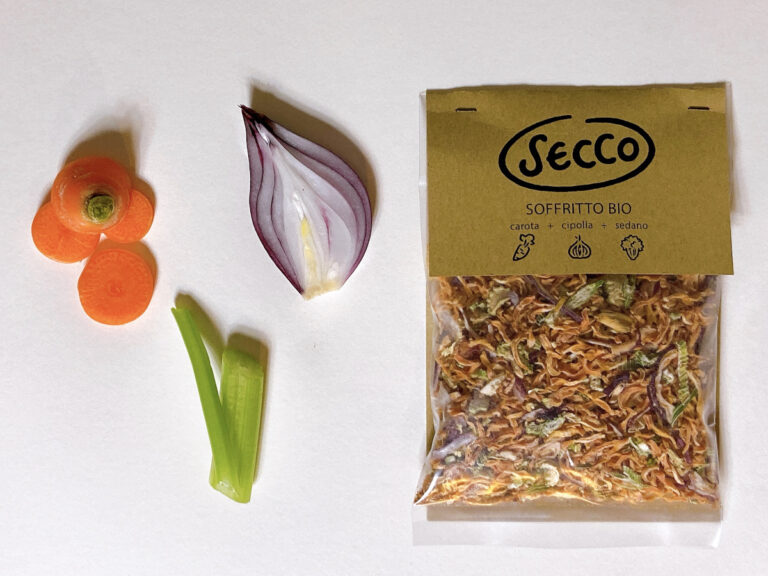
In the laboratory, produce is washed, sorted and cut, and then subjected to a cold, low-temperature dehydration process powered by a solar dryer. This technique preserves nutrients, flavor and antioxidants, extending the useful life of the vegetables. The result is the “Dry” line: portioned, ready-to-use organic vegetable seasonings ideal for enriching everyday dishes such as pasta, soups, omelettes, pizzas and pies.
Secco Bio’s mission goes beyond food preservation. By transforming agricultural surplus into products with high added value, it strengthens the short supply chain, supports organic farmers in central Italy and promotes agro-biodiversity. The project is a concrete example of circularity, promotes food security and allows farmers to monetize what would otherwise be lost.
In addition, collaboration with the Department of Agronomy at the University of Perugia confirmed thehigh content of antioxidants maintained in dehydrated vegetables.
Dry Bio offers consumers a healthy, sustainable and practical alternative to fresh produce, without compromising taste and nutritional values. In essence, the project represents a virtuous model of environmental responsibility, community enhancement, and innovation in food preservation, demonstrating how local initiatives can truly contribute to reducing waste and building sustainable food systems.
Bibliography
- Cicatiello, C., Franco, S., Pancino, B., & Blasi, E. (2016). The value of food waste: An exploratory study on retailing. Journal of Retailing and Consumer Services, 30, 96-104 . https://www.sciencedirect.com/science/article/abs/pii/S0969698916300078?via%3Dihub.
- D. Sangiovanni, personal communication, June 3, 2025
- Dry Bio. (n.d.). About Us – Dry. Retrieved June 13, 2025, from https://www.seccobio.it/chi-siamo-secco/