Country: America
Address: New York, 130 7th Ave #130.
Type of reality: Company
Target audience: B2C, B2B
Web site: https://www.rindsnacks.com/
Scenario
Fruit is one of the types of food that is most easily wasted and thrown away in our society, at all stages of its life: in the fields, during harvest, during transportation, in processing plants, in distributors, in stores, and in people’s homes. According to Nirmal et al. (2023), global fruit and vegetable waste accounts for 46 percent of total global food waste. Currently, industries are trying to combat this unsustainable and wasteful behavior by reusing these valuable resources.
Fruit waste can be used as an efficient bio-absorbent for the purpose of absorbing toxic pollutants from various industries such as mining, textiles, and many others. This would be a great change from the current standard of using activated carbon, which is expensive and therefore is used in a limited way. In addition, fruit waste has also been used for the production of renewable energy sources, such as bioethanol, biogas, and biohydrogen.
On the other hand, the use of fruit waste has almost unlimited uses in edible uses due to its rich nutritional values and bioactive components. These are, for example, proteins, dietary fibers, polysaccharides, phytochemicals, phenolic compounds, dietary fibers, and flavonoids that have various health benefits, including antioxidant, anti-inflammatory, antimicrobial, and anticancer properties. These benefits are of great value in the food industry due to their use for food fortification and preservation.
Description
Rind was founded by Matt Weiss in 2017 as a side job in New York City.
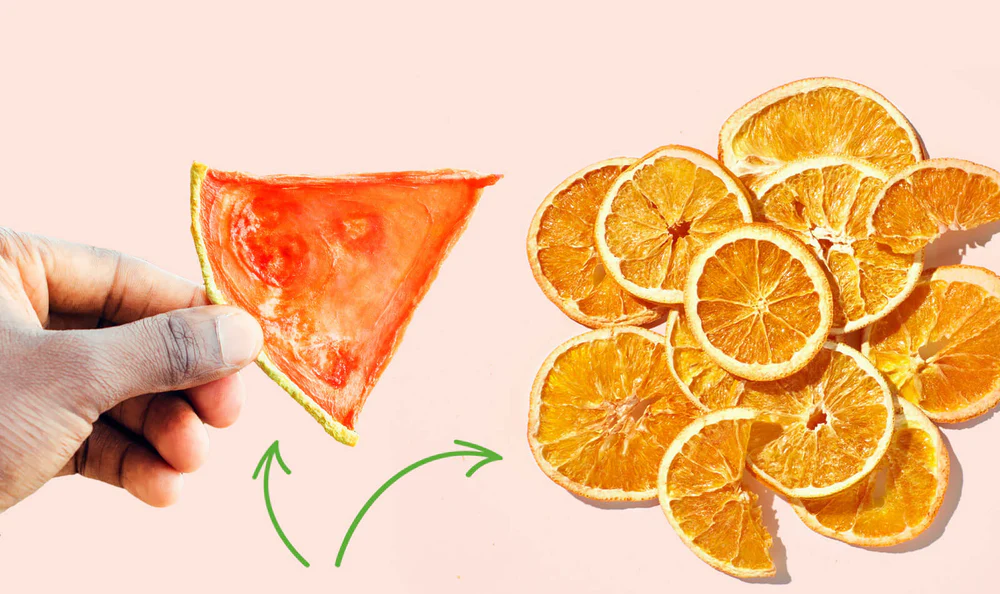
It is a company that turns peels and rinds that would normally go to waste into dehydrated snacks.
The dehydration process is done slowly and at a low temperature to retain most of the nutrients , and there is no addition of sulfites to the product.
The company offers a wide range of product types ranging from different textures, fruits and blends.
Their work to minimize food waste has grown steadily from 135 tons of edible peels in 2021 to 450 tons in 2022.
Bibliography
- Savage, S. (2022, June 7). A Novel Way To Prevent Food Waste And Up-cycle Fruit. Forbes. https://www.forbes.com/sites/stevensavage/2022/06/07/a-novel-way-to-prevent-food-waste-and-up-cycle-fruit/
- This Simple Mantra Is At The Core Of RIND’s $25M Success Story. (2024, March 19). [Registrazione audio]. https://open.spotify.com/episode/33R5mzOjxaFozWPLkBwTrc
- Nirmal, N. P., Khanashyam, A. C., Mundanat, A. S., Shah, K., Babu, K. S., Thorakkattu, P., Al-Asmari, F., & Pandiselvam, R. (2023). Valorization of Fruit Waste for Bioactive Compounds and Their Applications in the Food Industry. Foods, 12(3), Article 3. https://doi.org/10.3390/foods12030556