Fact sheet written by Lorenzo Bergamasco from the Gastronomic Design Sciences course of the UNISG Bachelor of Science in Gastronomic Sciences and Cultures degree program
Country: Ireland
Address: Clonakilty, Co. Cork, Ireland.
Type of reality: Startup
Target audience: B2B; B2C
Web site: www.mygug.eu
Scenario
In Europe, the issue of sustainable food waste management has become central to public debate and environmental agendas. Approximately 931 million tons of food is wasted worldwide each year (UNEP, 2021), and about 1.1 million tons of food waste is produced in Ireland alone, a figure that reflects not only inefficiencies in the food supply chain but also poor recovery at the household and commercial level.
With the growing urgency to meet European decarbonization targets, there is a push toward decentralized, autonomous and circular energy models that can produce renewable energy from local sources, such as organic waste. In this context, the use of domestic biogas emerges as a practical solution to reduce dependence on fossil fuels and cut greenhouse gas emissions.
At the same time, growing awareness of environmental sustainability and social responsibility is driving consumers, schools and businesses to look for solutions that can combine environmental education, energy conservation and waste reduction. The need for technologies that are compact, easy to use, and installable in urban and rural settings is increasingly being felt.
Description
MyGug is a startup founded in Ireland in 2021. The idea grew out of the experience of a family with a strong focus on environmental sustainability and circular waste management. Living in a rural area, the founders decided to create a system to turn household food waste into clean energy, reducing environmental impact and promoting energy self-sufficiency.
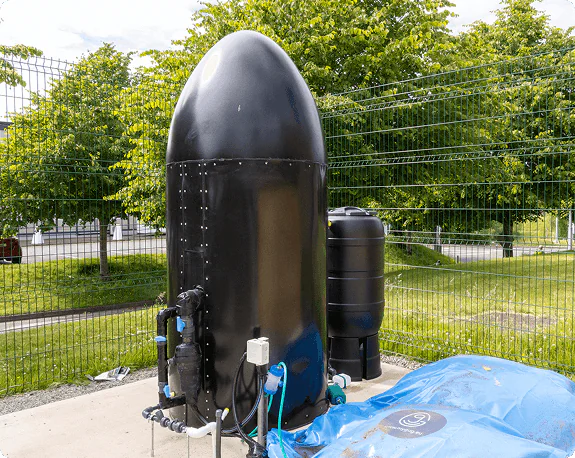
MyGug has developed an egg-shaped household biodigester designed for use by households, schools, farms, and small businesses. The system works simply and continuously: simply place food scraps inside the digester, which turns them into biogas that can be used for cooking and liquid fertilizer for the garden or vegetable garden. The process is completely closed, odorless, and works year-round, even in cold climates.
The device uses an anaerobic digestion process, during which bacteria decompose organic waste, producing methane. The biogas is stored in a tank and can be connected directly to a kitchen stove. The liquid residue released is rich in nutrients and is perfect as a natural fertilizer. The system is designed to be easy to use, requires little maintenance, and can handle up to 2 kg of waste per day.
MyGug aims to simultaneously address several global problems: food waste, dependence on fossil fuels, and the need for local and sustainable energy solutions. Each installed system reduces CO₂ emissions , prevents waste from going to landfills, and promotes an affordable circular economy, even at the household level.
Bibliography
- United Nations Environment Programme. (2021). UNEP Food Waste Index Report 2021. https://www.unep.org/resources/report/unep-food-waste-index-report-2021
- MyGug. (n.d.). MyGug Anaerobic Digester for Business. https://mygug.eu/