Country: Netherlands
Address: Maasboulevard 100, 3063 NS Rotterdam, Netherlands
Type of reality: Company
Target audience: B2C
Website: fruitleather.nl
Scenario
In Europe, more than 50 million tons of fruits and vegetables are grown each year, but many of them do not reach supermarkets because of the strict aesthetic criteria imposed by European regulations and large-scale retail standards, thus ending up wasted. So the idea is to develop a method to reuse fruits and vegetables that would otherwise go unsold.
Description
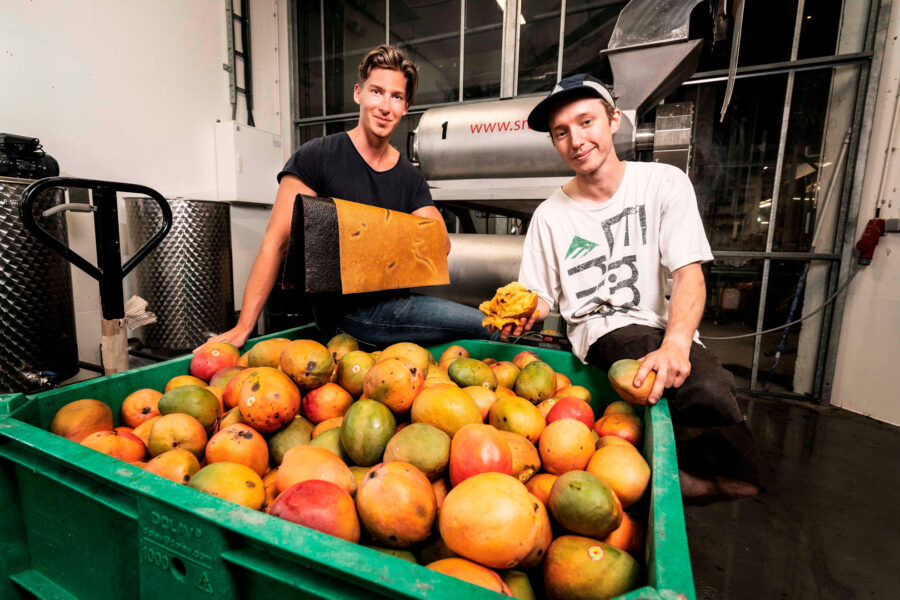
Fruitleather Rotterdam is a project conceived by two students from the Willem de Kooning Academie that aims to develop a new sustainable plant material derived from mango waste. This initiative tries to solve a widespread social problem: food waste and waste.
Every day in Rotterdam, a city with the largest port in Europe, considerable amounts of fruits and vegetables are discarded. In this regard, the two partners have made contacts with large-scale retail operators, enabling them to recover this food that would otherwise be destined for discard.
The making of the material follows several steps: initially, the seeds are removed from the fruit and the pulp is cut and crushed, then boiled to make it sterile. Next, the resulting pulp is mixed with additives, spread on special trays and allowed to dry. During the drying process, the color of the material changes depending on the type of mango used: for example, Palmer mangoes take on a brown hue, while Keitt mangoes turn black.
Originally the company dealt with different types of fruit (hence the name given to the company) but after some testing they learned that mango was the fruit that suited them best, since it has a lot of useful fiber inside it for skin production, and because it is one of the most imported fruits from Holland.
Currently, the two partners are striving, on the one hand, to create a 100 percent organic material that has no toxic solvents or other materials in it that are harmful to both humans and the environment, and on the other hand, they are trying to obtain a material that is very close in appearance and characteristics to animal skin.
Finally, an important goal is also to expand the starting material to more types of fruits and vegetables, so that more than just mangoes can be recovered.
To date, collaborations with this company are several:
- Key chains and wallets made in collaboration with Windmillkey or Allegorie Design;
- Bags made in collaboration with Vederwerk1;
- Several models of footwear made in collaboration with Claudio Pavone.
In conclusion, the problem of food waste becomes even more serious if we calculate that 10 percent of all greenhouse gases produced in developed countries are emitted just to produce food that will go unsold. It is therefore crucial to vigorously address both the problem of food waste and the need to reduce greenhouse gas emissions related to fruit and vegetable production.
Bibliography
- Ansa, A. (2023, September 27). FAO, as hunger grows 30% of food is wasted in the world – Institutions – Ansa.com. ANSA Agency. https://www.ansa.it/canale_terraegusto/notizie/istituzioni/2023/09/26/fao-mentre-cresce-la-fame-il-30-del-cibo-sprecato-nel-mondo
- Bonardi, B. (2018, September 3). One-third of European fruits and vegetables wasted for aesthetic reasons. University of Edinburgh study . Il Fatto Alimentare. https://ilfattoalimentare.it/frutta-verdura-europa-spreco.html
- Editing. (2022, October 7). Belgium and the Netherlands have the highest food waste. Openpolis. https://www.openpolis.it/numeri/in-belgio-e-nei-paesi-bassi-il-maggior-spreco-di-cibo/
- Editors. (2016, January 4). FRUIT LEATHER ROTTERDAM. RadioVeg.com. https://www.openpolis.it/numeri/in-belgio-e-nei-paesi-bassi-il-maggior-spreco-di-cibo/
- Amicone, I. (2022, October 14). Fruitleather, material from fruit waste. Superchio. https://www.superchio.it/fruitleather-tessuto-da-scarti-della-frutta