Country: Italy
Address: Via Alcide De Gasperi 26 36028 Rossano Veneto, VI, Italy
Type of reality: Company
Target audience: B2B
Web site: www.favini.com
Scenario
The Food and Agriculture Organization of the United Nations (FAO) defines food waste as “the decrease in the quantity and quality of food resulting from decisions and actions by retailers, food service providers and consumers.”
Food waste and waste management varies from country to country; in fact, while in low-income countries recycling is not done because of poor supply chain organization, in high- and middle-income countries there is little attention to the circular economy because of habits too closely linked to consumerism. For this reason, theuse of food waste in a product as common and accessible as paper can be a turning point.
Description
Favini is a company that has been making paper since 1736 following the Italian style. Since the 1990s, one of its main goals has been to create products in tune with nature, through more sustainable and high-quality processes and raw materials that bring innovative ideas to light. The company was born in Italy but has also expanded abroad, bringing to homes, studios and companies around the world the typically Italian aesthetic taste ,craftsmanship in every detail and the desire to seek more ecological solutions.
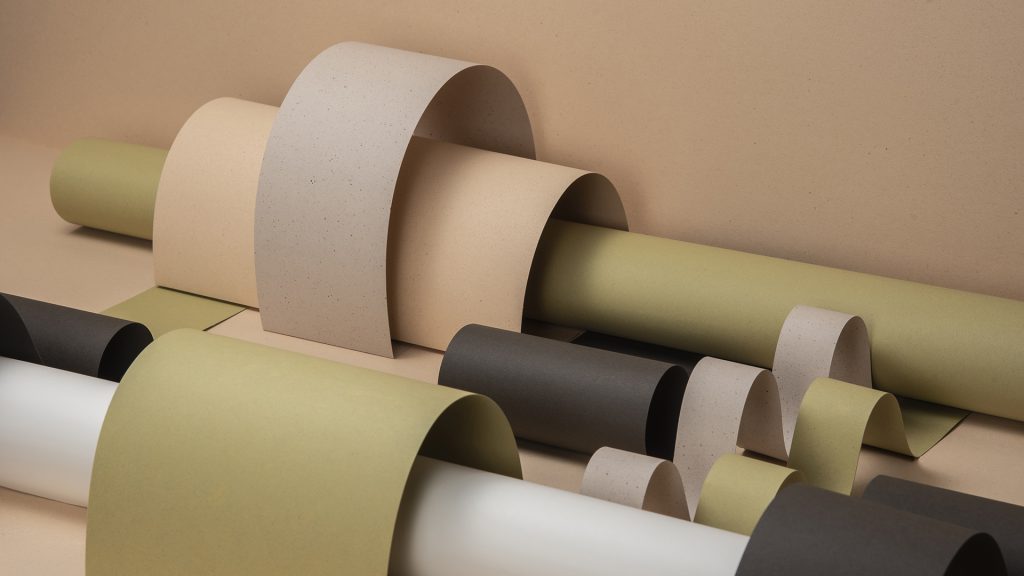
There are various designs and paper types including “Crush,” a range derived from agro-industrial waste that gained considerable attention after its performance at Luxepack Munich in 2012. Initially, the collection was limited to just seven colors each representing a specific ingredient obtained from citrus, corn, coffee, hazelnut, almond, olive and kiwi by-products. Over the years, however, research has been conducted that has led to an expansion of the range. Currently the collection has been nearly doubled by incorporating more colors.
Specifically, Crush is created from the creative reuse of 15 percent agro-industrial by-products, of which more than 40 percent are recycled fibers; it is made with self-generated energy and according to a monitored and constantly improved production process; it is FSC™ certified; and there is evidence of a commitment to being both recyclable and biodegradable .
Already many brands have decided to make packaging using the Crush range, including Domori, Barilla, Naturally Clicquot 3, Dior, La Brenta, and star chef Cracco for his restaurant. In fact, each of them chose to use a paper made directly from the waste of the ingredient they deal with, as in the case of Domori cocoa. Barilla, on the other hand, was one of the first companies to collaborate with Crush products by making Carta Crusca with bran that can no longer be used for food consumption, going so far as to replace 20 percent of the pulp from trees. A different project is the one created for the Miss Dior Rose Essence packaging is Rose Paper. After the roses have been processed into rose water, the residue is processed by Favini to make a sustainable paper, replacing 15 percent virgin pulp.
Bibliography
- Crush – Graphic specialties. (2024, May 30). Graphic Specialties. https://www.favini.com/gs/products/crush/#case_history
- Food waste: the circular economy as a sustainable solution. (n.d.). Umberto Veronesi Foundation. https://www.fondazioneveronesi.it/la-fondazione/newsdalla-fondazione/leconomia-circolare-puo-essere-unasoluzione-sostenibile-per-contrastare-lo-spreco-alimentare