Country: Indonesia
Address: Jl. Tebet Dalam I G No.21A 4, RT.4/RW.1, Tebet Bar., Kec. Tebet, Kota Jakarta Selatan, Daerah Khusus Ibukota Jakarta 12810, Indonesia
Type of reality: Multinational company
Target audience: B2C
Website: rethink-plastic.com
Scenario
Seaweed production is currently carried out in 50 countries, with an annual growth rate of 8% over the past decade (FAO, 2016). The leading producers of seaweed are China and Indonesia, which together produce approximately 23 million metric tons per year.
Algae have many different uses : they can be produced for direct human consumption as food or processed for use as additives, animal feed, fertilizers, cosmetics, and medicines.
However, the widespread use of single-use plastics in the food industry has contributed to the problem of microplastic debris ranging in size from 1 μm to 5 mm, as stated by Eriksen et al. (2014) and Sebille et al. (2015), who estimate that between 93 and 268 ktons of these microplastics are floating in the ocean and ultimately enter the food chain.
Description
Evoware is an Indonesian company founded to offer an alternative to single-use plastic and help curb the problem; specifically, it aims to replace this type of material in food applications, since about 70% of the plastic used in this sector ends up in the ocean.
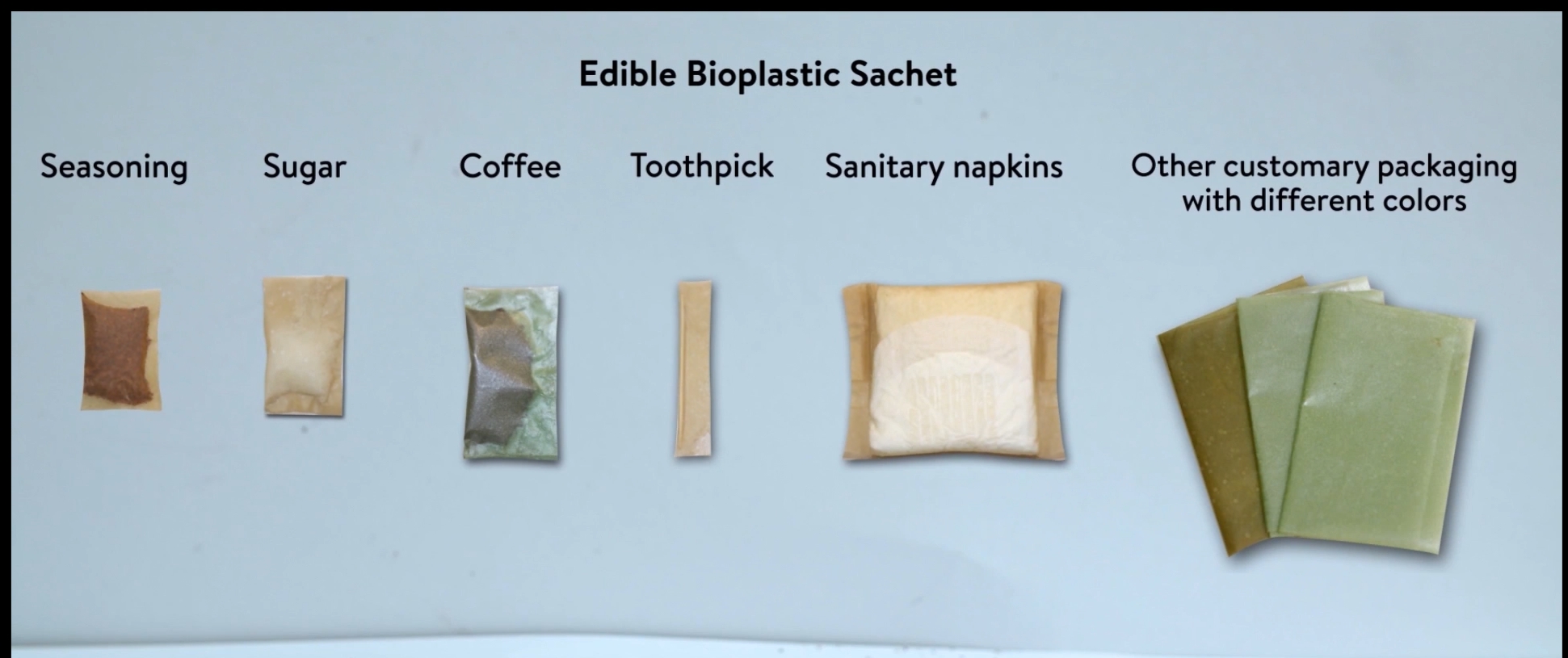
This bioplastic uses only natural ingredients and is water-soluble, making it very convenient for use in packages for instant coffee, condiments, or cereal. Since it is completely biodegradable, it does not need to be disposed of with other plastics but can be placed in the organic waste bin. In addition, through this new innovation, the company has patented a method to make the bioplastic water-resistant, allowing it to be used to hold liquids and semi-liquids.

The algae that Evoware uses for its patented bioplastic are cultivated in a way that is sustainable from both an ecological and social standpoint: this means that farmers are fairly compensated for their raw material if it is grown in an environmentally responsible manner. This new packaging is not only completely biodegradable but is also edible by the end consumer, thus becoming a source of nutrition for the consumer. Based on studies conducted by the company itself, Evoware has set several goals:
- increase farmers’ income by 62 percent, starting from the current 60 families to 1200 families of raw material suppliers in 2023, thus affecting their quality of life and enabling social as well as economic growth in the area;
- keep the 218 hectares of coastline clean and expand it to 5,408 hectares by 2023, thereby safeguarding the coastline and protecting it from environmental threats;
- Reduce plastic waste by 93 tons in 2018/2019 and 2400 tons by 2023;
- reduce CO2 emissions in Indonesia by approximately 558 metric tons by 2018/2019 and by 14,400 metric tons by 2023.
For its work, Evoware has been awarded two prizes: the first, from Social Venture Challenge Asia, in the “Idea” category in 2017; the second (also in 2017) from the Circular Design Challenge in the “New Plastics Economy” category. The Circular Design Challenge is part of the New Plastics Economy Innovation Prize, which is led by the Ellen MacArthur Foundation and partners with OpenIDEO to manage this competition.
Bibliography
- FAO. (2016). The state of world fisheries and aquaculture. Contributing to food security and nutrition for all . Rome.(http://www.fao.org/3/a-i5555e.pdf)
- Buschmann, A. H., Camus, C., Infante, J., Neori, A., Israel, Á., Hernández-González, M. C., … & Critchley, A. T. (2017). Seaweed production: an overview of the global state of exploitation, farming, and emerging research activity. European Journal of Phycology, 52(4), 391–406.
- Eriksen, M., Lebreton, L. C., Carson, H. S., Thiel, M., Moore, C. J., Borerro, J. C., … & Reisser, J. (2014). Plastic pollution in the world’s oceans: more than 5 trillion plastic pieces weighing over 250,000 metric tons floating in the sea. PLoS ONE, 9(12), e111913.
- Van Sebille, E., Wilcox, C., Lebreton, L., Maximenko, N., Hardesty, B. D., Van Franeker, J. A., … & Law, K. L. (2015). A global inventory of small floating plastic debris. Environmental Research Letters, 10(12), 124006.
- Lassen, C., Hansen, S. F., Magnusson, K., Hartmann, N. B., Jensen, P. R., Nielsen, T. G., & Brinch, A. (2015). Microplastics: occurrence, effects, and sources of releases into the environment in Denmark.
- Evoware: www.evoware.id“Evoware Profile and Business Plan” https://d3gxp3iknbs7bs.cloudfront.net/attachments/90bdc0d4- 5187-4891-805b-8d89d16bf304.pdf
- OpenIdeo: https://www.openideo.com/?_ga=2.216704342.152913840.1530520162- 1070581018.1529849433