Fact sheet written by Hudra Bagaliza, Gaia Cappelletti from the Gastronomic Design Sciences course of the UNISG Bachelor of Science in Gastronomic Sciences and Cultures degree program
Country: Uganda
Address: Uganda, Kampala
Type of reality: Non-profit organization
Target audience: B2C
Claim: Waste isn’t waste until you waste it
Web site: www.ekibbo.org
Scenario
Uganda is a sub-Saharan African country still classified as low-income. Despite a rapidly growing population, the country continues to suffer from widespread poverty. The most recent national estimates (2019/2020) indicate that 20.3 percent of the population lives below the national poverty line, which is even lower than the international average (World Bank, 2023). However, considering multidimensional poverty, 2016 data estimate that at least 57.2 percent of the population is affected, with an additional 23.6 percent vulnerable to poverty risk (United Nations Development Program, 2023).
The capital, Kampala, has the fourth highest urban growth rate on the African continent, and it is in the urban centers that the highest levels of poverty and inequality are concentrated. Rapid growth has generated serious problems of housing shortages, traffic congestion, pollution and uncontrolled expansion of peri-urban areas. As a result, slums and informal settlements are expanding rapidly (Richmond et al., 2018).
Uganda is among the African countries with the highest number of slums (Omulo et al., 2017). In Kampala, they occupy at least a quarter of the city’s total area and house about 60 percent of the population (Richmond et al., 2018). Katanga, where the Ekibbo project operates, is one of the largest slums in Kampala. It is located between
A major factor fueling poverty in Katanga, particularly among women, is lack of education and high illiteracy rates. Low educational levels make access to well-paid jobs difficult, perpetuating a
Girls are often withdrawn from school to be given in marriage in exchange for a dowry, a practice that deprives them of the opportunity to become self-reliant and traps them in long-term poverty. Many of them, in order to meet basic needs, are pushed into risky sexual behavior, including prostitution, thus increasing their exposure to HIV/AIDS and other sexually transmitted infections (Barigye, 2010).
HIV/AIDS has been a serious problem in Uganda since the 1980s. An estimated 60 percent of infected adults in Africa are women, many of whom contract the virus at a young age. The main causes lie in economic dependence, which limits the ability to choose when, with whom and under what conditions to have sex.
According to several studies, the most effective form of prevention is to encourage the development of microenterprises, which can provide sustainable economic alternatives and reduce the need for paid sex (Barigye, 2010). Organizations such as Ekibbo, which help women generate independent income and become self-sufficient, are therefore essential.
Another serious problem in Uganda isplastic pollution. With population growth and increasing consumption, the use of
The capital produces between 1,200 and 1,500 tons of waste per day, but only a third is collected. City authorities spend more than $1.5 million a month to dispose of just 30 percent of the waste produced (Wandeka et al., 2022). Much of the problem stems from the lack of road infrastructure, which prevents trucks from accessing the most densely populated informal settlements (Richmond et al., 2018).
Plastic that is not recycled ends up in landfills or dispersed into the environment (79 percent), or is burned open (12 percent), generating air and water pollution. In Kampala, it is the main cause of clogged sewage systems and flooding during the rainy season. Toxic emissions from plastic burning are related to respiratory problems, includingchildhood asthma, which affects about 14 percent of children aged 8 to 14 (CARE, 2019).
Plastic takes over 450 years to decompose, contaminating lakes, rivers and marine ecosystems. According to the United Nations, plastic pollution causes the death of about one million seabirds and 100,000 aquatic animals each year, and could kill more people than malaria and HIV/AIDS combined (CARE, 2019).
For this reason, innovative solutions such as the one proposed by Ekibbo, which transforms plastic waste into handicraft products by giving them new value and preventing their dispersion into the environment, are crucial.
Description
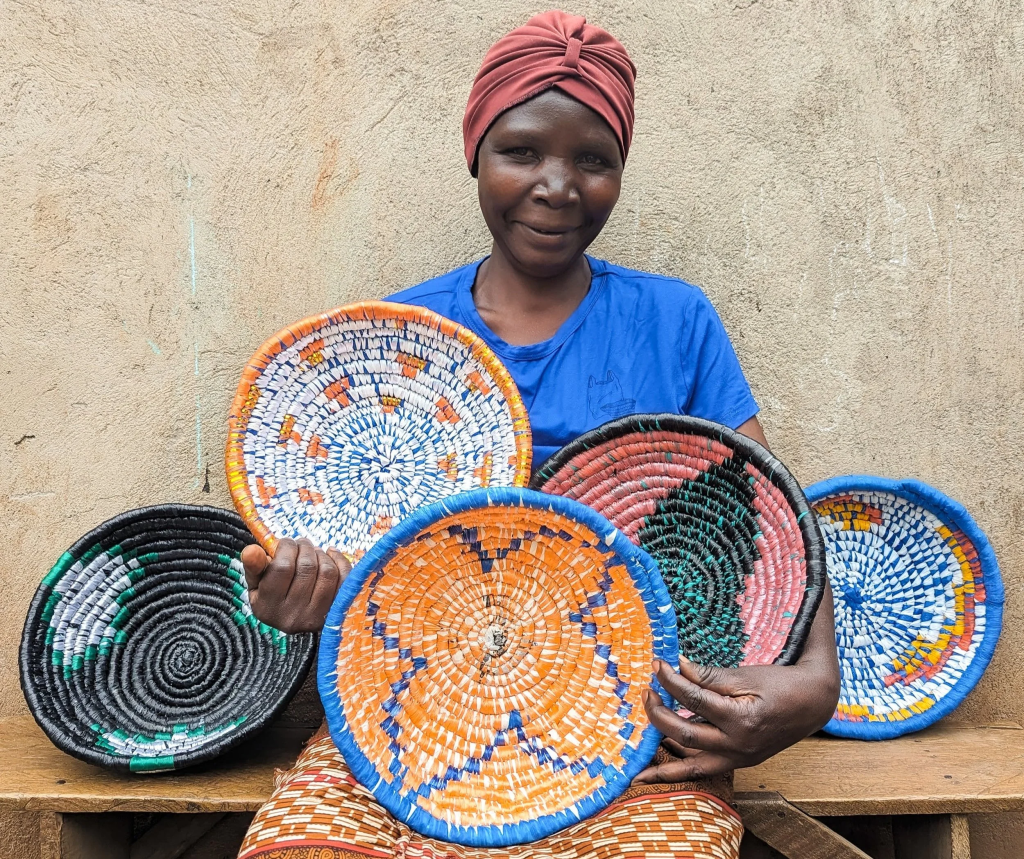
Ekibbo is anonprofit organization operating in the Katanga slum of Kampala, Uganda, and is a concrete example of a circular economy for capital. Through the transformation of plastic waste into handicraft products, Ekibbo contributes not only to environmental regeneration, but also to strengthening the economic, human, social and cultural capital of the community.
The project is the brainchild of Belgian designer Sam Vandermaesen, who decided to put her skills to work in the service of reducing plastic waste in Uganda by making furniture and accessories from discarded materials.
It all started with the creation of a basket woven from plastic bags, sold for 10 euros, a sum equivalent to a monthly salary for slum dwellers. The success of this first object aroused great interest in Belgium, where many people wanted to buy one. This is also the origin of the project’s name, as Ekibbo means precisely “basket” in Luganda, the local language.
In 2021, the initiative officially became a nonprofit organization. And today, Ekibbo produces not only baskets made entirely from recycled single-use plastic, but also Masiki, traditional Ugandan cultural masks reinterpreted with materials such as plastic and woven bags.
The most recent project, Ekiwempe, consists of a fragmented wall carpet created directly in the Katanga neighborhood. The work can be sold as individual pieces or as a complete composition and, when assembled, depicts a scene of daily life: houses around the open drainage channel and women engaged in daily activities.
Through these productions, women in the neighborhood are contributing to environmental regeneration. Indeed, the area suffers from
On the level of economic capital, Ekibbo plays a crucial role. Through the sale of handicrafts, the organization generates local income for women, teaching them how to create value from waste and supporting the development of microenterprises.
The income earned is fair and flexible, allowing women to manage their own time, working from home and in creative autonomy. Some of them even manage to
Ekibbo also fosters the growth of human and social capital. By hiring and training women in the community, the organization promotes
Finally, Ekibbo also contributes to the enhancement of Uganda’s cultural capital. Through the integration of traditional motifs and local symbolism into its recycled creations, the organization preserves and renews the country’s artistic heritage and identity, ensuring that local traditions continue to be passed on and celebrated by new generations.
Bibliography
- Barigye, F. (2010). The impact of poverty on increasing rates of HIV/AIDS among young girls and women in Kampala: A case study of Katanga region (Doctoral dissertation, College of Humanities and Social Sciences). https://irbackend.kiu.ac.ug/server/api/core/bitstreams/1bf97682-db2c-45c2-b2be-2c424cdf3a32/content
- CARE. (2019, November 4). *Plastic waste recycling and production facility in Ugandan refugee settlements: Innovation challenge* (Request for Proposal). UNHCR Operational Data Portal. https://data.unhcr.org/en/documents/download/72435
- Ekibbo. (n.d.). https://www.ekibbo.org
- Omulo, G., Muhsin, M., Kasana, I., & Nabaterega, R. (2017). A proposal for empowering slum dwellers as a viable way of addressing urbanization challenges in Katanga slum, Kampala, Uganda.Environmental Engineering Research, 22(4), 432-438 . https://www.eeer.org/journal/view.php?doi=10.4491/eer.2017.013.
- Richmond, A., Myers, I., & Namuli, H. (2018). Urban informality and vulnerability: a case study in Kampala, Uganda. Urban Science, 2(1), 22 . https://www.mdpi.com/2413-8851/2/1/22.
- United Nations Development Programme. (2023). *Uganda: Multidimensional poverty index country profile*. Human Development Reports. https://hdr.undp.org/sites/default/files/Country-Profiles/MPI/UGA.pdf
- Wandeka, C. M., Kiggundu, N., & Mutumba, R. (2022). Plastic packaging: A study on plastic imports in Uganda. https://nru.uncst.go.ug/server/api/core/bitstreams/2e92bfff-e817-4e19-bd9f-95e5dc28e8f2/content
- World Bank. (2023, April 21). Uganda poverty assessment 2023: Strengthening Uganda’s resilience to poverty and vulnerability. https://documents.worldbank.org/en/publication/documents-reports/documentdetail/099523204222530354