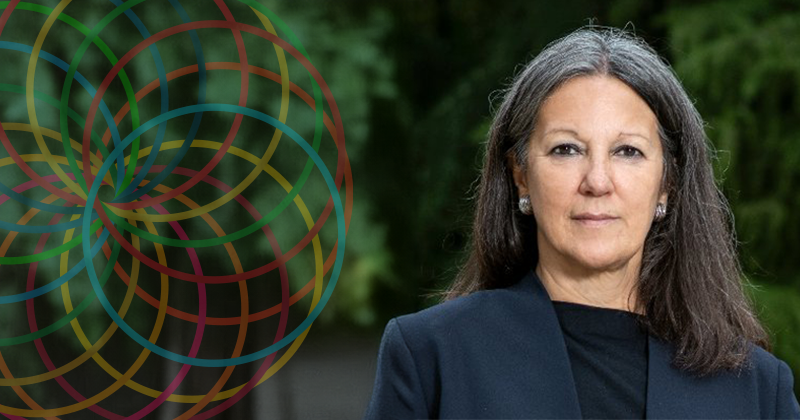
“The Bioeconomy, if declined in the circular logic, as land regeneration, with soil health at the center, can be an essential tool of European strategies and policies to curb climate change phenomena in the short term and to make possible what I call the ‘doing more with less.'” Doing more with less to create a truly sustainable balance between man and nature, between markets and the law, between private consumption and public goods, this is the mission of Catia Bastioli, CEO of Novamont S.p.A., President of Kyoto Club and former President of Terna.
Pioneering green chemistry, bioeconomy of biomass, waste and by-products, applied R&D in technological innovation for ecological transition and soil regeneration. Among the first in our country to push for the abandonment of a linear economy in order to decisively direct the prow towards an environmentally and soil-friendly economy governed by ethical principles capable of redefining individual and collective awareness of production and consumption, including through the redefinition of corporate social responsibility and its objectives. A viable and economical circular movement that knows how to make the most of, for example, agricultural waste, just as Novamont has been able to do through MaterBi, the compostable and biodegradable bioplastic of shopping bags. An international patent filed, along with hundreds of others, by her own. In the belief that the future is and will be increasingly linked to innovation that is fully respectful of the environment and embedded in a productive industrial mosaic that is the result of sustainability and a structural and identity-based symbiosis between matter and consumption. A line of principle he has followed since he guided Novamont, a leading bioplastics producer since the 1990s, toward the 2012 acquisition of a decommissioned plant from Japan’s Ajinomoto to start the world’s first industrial plant in the production from renewable sources of biobutanediol. That is, from sugars that, through the use of bacteria, actually decreased the net global warming potential of Mater-Bi bioplastics by more than 50 percent in CO2 emissions compared to the fossil alternative.
Also as president of the Kyoto Club, the nonprofit organization made up of businesses, entities, associations and local governments committed to achieving the greenhouse gas emission reduction targets set by the Kyoto Protocol, EU-level decisions and the December 2015 Paris Agreement, he works to redefine the paradigm that puts environmentalism in sharp and natural opposition to biochemistry. Through a precise taking of individual and collective responsibility and a profound change in mentality that can generate the cultural leap needed to put into practice a truly regenerative economy. That is, a medium- to long-term strategy that knows how to produce clear and immediate effects on the planet and many thousands of jobs: “to face constructively, courageously and in a spirit of service the epochal challenges of a transition that can no longer be postponed, starting with our territories.”
As a member of the scientific committee for the European research mission Soil Health and Food, she is, in addition, engaged in regeneration projects capable of restoring 75 percent of all soils in each member state to health by 2030. All with a systems approach, combining research and innovation and taking into account that in Europe we have an average of 70 percent of agricultural soils at risk of eutrophication, 24 percent of soils subject to erosion and 25 percent at high risk of desertification.