


Fact sheet written by Christian Abrate, Viola Ghitti, Nicola Silipo Caliò from the Gastronomic Design Sciences course of the UNISG Bachelor of Science in Gastronomic Sciences and Cultures.
Country: Croatia
Address: Fažanska cesta 38/A, Vodnjan.
Type of reality: Farm
Target audience: B2B; B2C
Web site: www.cadenela.com
Scenario
Theabandonment of rural areas in favor of cities is a well-known phenomenon that began with the industrial revolution and has continued to the present day. Today it is estimated that about 11 percent of agricultural land in the European Union is at risk of abandonment (Pepiňa et al., 2018). Croatia, like many European countries, also lives with this phenomenon, which affects not only agricultural land but also villages and small towns, some of which have become real “ghost towns” (Loncar & Pavić, 2020). This process is often linked to theemigration of the population to other nations, driven by economic or political reasons.
The causes of abandonment are many. First, depopulation of rural areas has led people to leave agricultural work in favor of big industry. Added to this is the decline in agricultural profitability, a consequence of soil depletion, and the globalization of agricultural markets, which has led to lower commodity prices, making farming less convenient (Gnesini, n.d.).
The consequences of abandonment vary according to geographic location and land status. On the one hand, it can promote ecological restoration, increase carbon storage, and improvehabitat quality (Aide et al., 2004). Some studies in the Mediterranean basin indicate that abandonment can lead to a slight increase in biodiversity, with greater richness and abundance of animal and plant species (Plieninger et al., 2014). On the other hand, however, abandonment reduces land development opportunities, leaving natural resources without a use, and results in the loss of rural livelihoods and agricultural and forest products (Marino & Felici, 2022).
Faced with this situation, regeneration of abandoned natural capital becomes crucial. Although there is no universal method to protect the ecosystem and at the same time use resources sustainably, targeted ecosystem management, if done correctly, can benefit both the owner and theenvironment (Plieninger et al., 2014).
Description
In 2009, when Giuseppe Lupieri’s father reached retirement age and expressed a desire to devote himself toagriculture, Giuseppe decided to follow the same path, founding theCadenela farm, based in Vodnjan. The farm’s land stretches between Pula, the Brijuni Islands, and Rovinj. The family owned some abandoned land, once cultivated with many olive trees, but long neglected.Istria, in fact, has been known since the time of the Roman Empire for the production of fine oils. For this reason, it was decided to clear the land and plant different varieties of olive trees in order to produce extra virgin olive oil. In this way, the owner was able to enhance a resource-rich land that had long been unused.
From 2009 to the present, Cadenela has acquired additional land, eventually developing 30 hectares of specialized olive groves, with about 7,000 trees of many varieties. The most common are: Bianchera, Busa and Rossignola, native varieties, and Leccino, Pendolino and Leccio del Corno, Italian varieties. The presence of many varieties is not accidental: in addition to reducing the impact on the landscape, it promotes greater biodiversity, as each plant possesses different agronomic and organoleptic characteristics, reflecting in the quality of the oil (Perri, 2017).
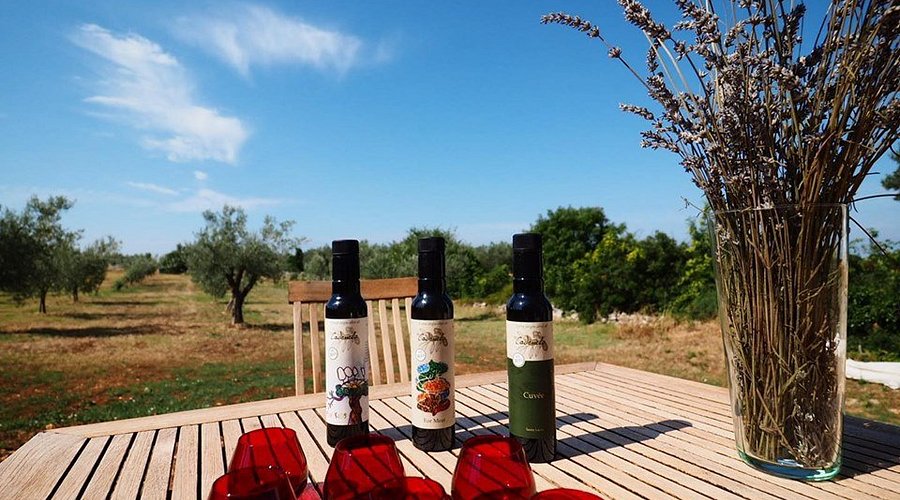
The company produces three types of oil. The most versatile is “Cuvée St Lucia,” a blend of Bianchera, Blusa, Rossignola, Carbonazza, Leccino, Pendolino and Leccio del Corno. Then there is the “For Kids” oil, sweeter and with a low degree of bitterness, and the “For Meat” oil , designed to accompany meats such as steaks and game, characterized by a high degree of spiciness and awarded numerous international awards.
With a view to minimizing the impact on theecosystem, Cadenela’s extra virgin olive oil is organic, with a limited number of treatments and the exclusive use of natural products when necessary (Agricola Conforti, n.d.). The elimination of pesticides and chemical fertilizers, along with the decision not to uproot wild plants, keeps the soil fertile and increases its biodiversity, which is often greater than that of the original forests. The few treatments also allow for reduced energy consumption, avoiding soil compaction and preserving soil aeration.
The commitment to sustainability is also reflected in the management of historical and natural heritage. Existing dry stone walls have been restored and maintained as natural fences, avoiding new construction. A centuries-old trullo on the property has also been recovered and converted into storage for tastings. All organic waste is used to produce humus and fertilize the following year’s plants. In addition, Cadenela collaborates with companies that extract polyphenols from olive leaves to reuse them in medical products and offers clients the possibility of adopting an olive tree, guaranteeing half a liter of oil annually and the assurance that the surrounding soil is not chemically treated.
Thanks to these interventions, Cadenela’s land has changed from abandoned forests to productive olive groves, with increased fertility and animal and plant biodiversity. The company is thus contributing to the development of the area, enhancing it and making it known, demonstrating how sustainable agriculture can transform a forgotten area into a valuable resource.
Bibliography
- Agricola Conforti. (n.d.). Organic vs. Conventional Olive Oil: What is the Difference? https://www.agricolaconforti.it/olio-evo-biologico-vs-convenzionale-qual-e-la-differenza
- Aide, T.M., Grau, H.R. (2004). Globalization, migration, and Latin American ecosystems. Science. 305. 1915-1916. https://doi.org/10.1126/science.1103179
- Cadenela. (n.d.a). Our orchards. https://www.cadenela.com/our-orchards/
- Cadenela. (n.d.b). Our oils. https://www.cadenela.com/our-oils/
- Gnesini, A. (n.d.). The consequences of abandonment of cultivated land. AboutPlants. https://www.aboutplants.eu/notizie/ricerca/le-conseguenze-dellabbandono-delle-terre-coltivate
- Loncar, S., Pavić, D. (2020, December). Areas with Abandoned and Vacant Properties In Croatia: a Plea for Recognition, Research, Policies and the Development of Regeneration Strategies. Etnološka tribina 43. 50. 197-237.
- Marino, D., Felici, F.B. (2022, May). Land abandonment what impacts for us and our planet? In SiBaTer (ed.). The role of the partnership in the SIBaTer Project: lessons learned and the future of the Bank of the Earthfrom the perspective of the partners. 135-153.
- Perpiňa Castillo, C., Kavalov, B., Diogo, V., Jacobs-Crisions, C., Batista e Silva F, Lavalle, C. (2018 October). Agricultural land abandonment in the EU within 2015-2030. European Commission.
- Perri, E. (2017, November 10). A large collection of olive varieties. Olive and oil. https://olivoeolio.edagricole.it/ricerca-scientifica/grande-collezione-biodiversita-olivicola/
- Plieninger, T, Hui, C., Gaertner, M., Huntsinger, L. (2014, May 27). The Impact of Land Abandonment on Species Richness and Abundance in the Mediterranean Basin: A Meta-Analysis. . PLOS ONE. https://doi.org/10.1371/journal.pone.0098355


