


by
Sustainability and Circular Economy Workshop
Pollenzo University of Gastronomic Sciences
It happens to everyone to have leftover food from time to time, but before throwing it away, try reusing it in creative ways. Did you know that many traditional Italian dishes originated in the act of recombining leftovers? For example, the Ravioli del Plin – the term Plin means “pizzicotto” in Piedmontese dialect and stands for the characteristic gesture of pinching the pasta with the fingers to enclose the filling between one raviolo and the next-they originated in the twentieth century in the Langhe, Monferrato and Roero area (Piedmont, Italy) as a dish made of fresh egg pasta filled with meat and stewed vegetables left over from the day before. But we can go even further back in time with the more international Meatballs (in Italian, Meatballs), a dish that originated in Roman times, between 25 B.C. and 35 B.C., using leftover boiled meat from various cuts of different animals. Circularity in cooking also requires that each part of a product be enhanced, as is the case in the example below of pumpkin in which: the pulp can be blended to make a cream that can be used as a base for a soup, flan, dessert, or puree; the seeds and strands can be dried for further use as crunchy ingredients or snacks; the peel can be boiled to make a broth that flavors our soups and sauces, or it can be used to make a jam and candied, pickled, or dried (Fassio et al., 2021).
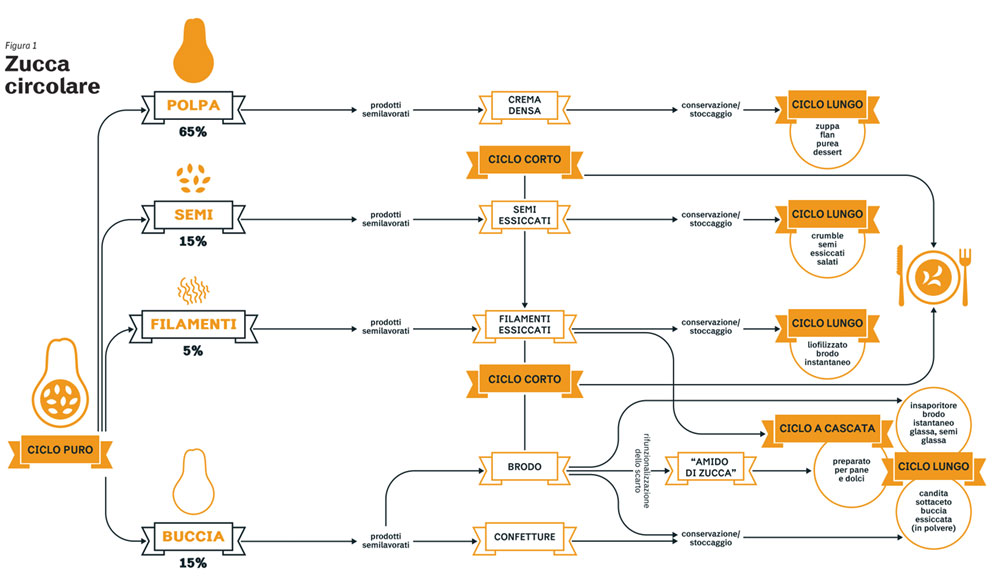
Pumpkin circularity: an example of a menu resulting from the total use of a butternut squash. From the whole ingredient, through its parts, we go on to define the possible semi-finished products that can be used to create different courses in the spirit of the circular economy.
Bibliography
Fassio, F., Tecco, N., Povigna, C., & Buracco, N. (2021). The circular kitchen between tradition and innovation. Renewable Matter, (37), 22-26.


