Country: Italy
Address: Via Cassia per Siena, 133 Località Bargino, San Casciano Val di Pesa, Florence
Type of reality: Winery
Target audience: B2C, B2B
Web site: www.antinori.it
Scenario
The topic discussed is based on data from 2017 on the Italian wine sector providedby the Wine Observatory, a project promoted by the Italian Wine Union under the supervision of the Ministry of Agricultural Policies.
- There are 310,000 wineries in Italy, 21 percent of Italian agricultural enterprises;
- Positions employed: 1.25 million workers throughout the supply chain;
- Production: 46 million hectoliters of wine, of which 3.025 million hectoliters were produced in Tuscany alone;
- Hectares of vineyards: 637,634 (4% of the UAA, Utilized Agricultural Area), of which 334,000 are dedicated to major appellations—52% DOCG and DOC—and 156,000 (24%) to IGT;
- Denominations of origin: 73 DOCG, 332 DOC, 118 IGT. In Europe we represent the country with the most designations.
These figures help us understand how this sector is of great importance in Italy and plays a fundamental role in agriculture—and beyond. The reputation that wine is building in the 21st century is anything but trivial. Most producers are gradually working to promote and protect the environment around us and to make the entire process as sustainable as possible, including through design approaches related toeco-design.
Description
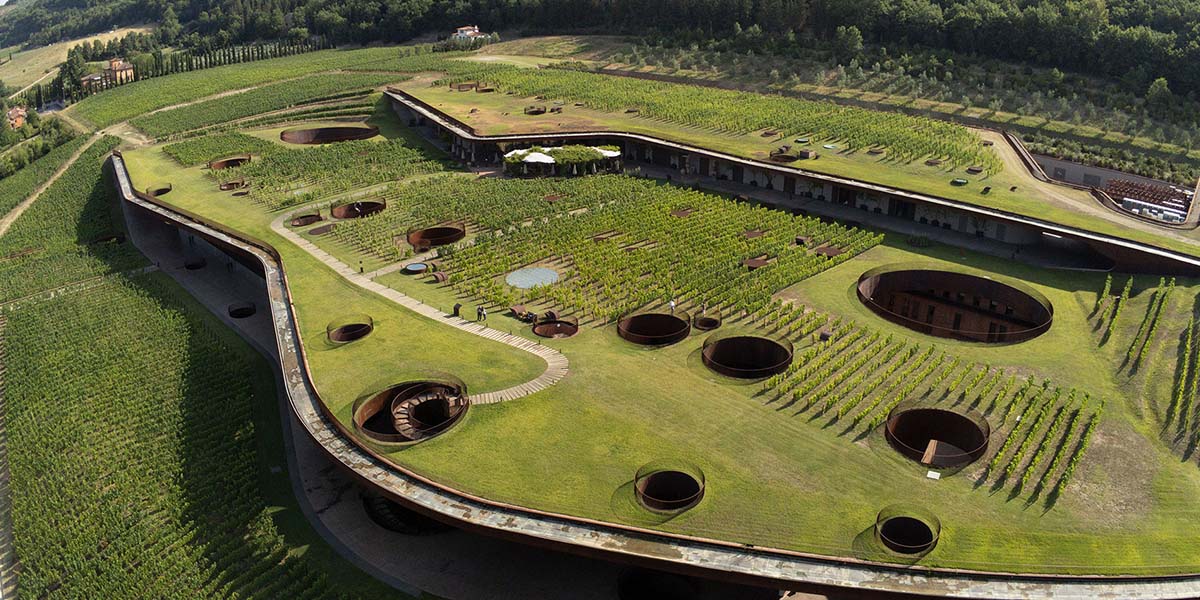
Marchesi Antinori is a historic Tuscan winery. However, this article will not focus on wine, but rather on the innovations associated with their winery—a shining example of a structure that adheres to the principles of sustainable design. The winery is virtually invisible from the outside, except for two long horizontal slits that cut through the hillside and form the building’s facade. It represents the most authentic expression of a deliberate symbiosis between human culture, the work of man, his work environment, and the natural environment.
The project integrates the built environment into the rural landscape, where the industrial complex is concealed by a canopy that defines a new level of cultivated land, where several grape varieties —unknown to most but long used in the history of Chianti—are grown: Canaiolo, Ciliegiolo, Colorino, Malvasia Nera, Mammolo, and, of course, the famous Sangiovese. It should be noted that not only the surrounding landscape but also the neighboring towns and homes have thus been left completely unaffected from both a visual and environmental standpoint.
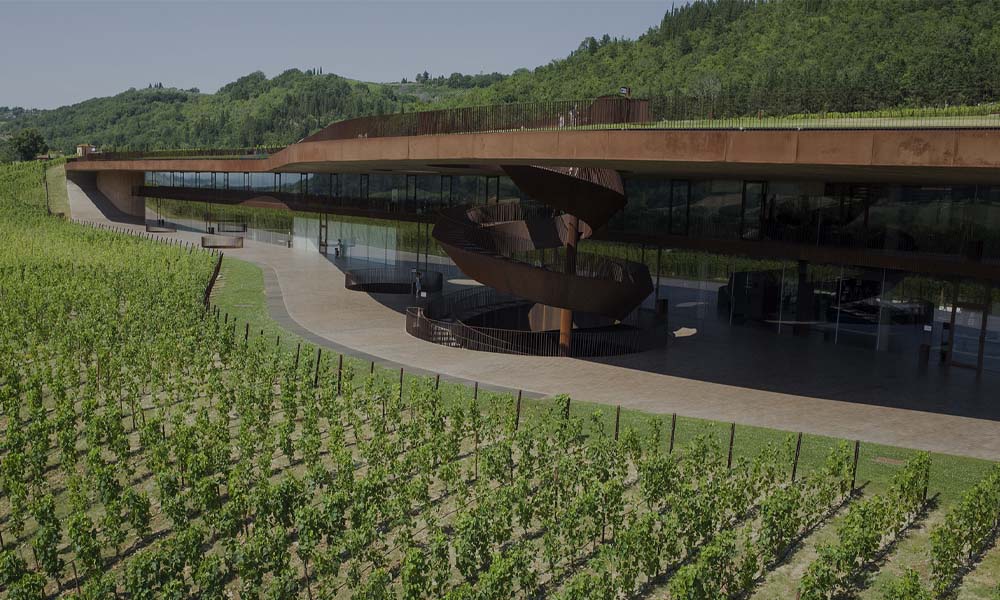
The architecture of this facility is designed to make the most of the forces found in nature. Gravity plays a central role: winemaking, in fact, takes place through a process that flows from top to bottom, allowing the grapes arriving at the winery to move through the facility with minimal energy expenditure and eliminating the need for pumping systems. The materials and techniques used in the construction and installation of the winery inside the hillside have created a microclimate and temperature that are ideal not only for the winemaking process but also for the aging of the wine itself.
This unique architectural design was created to avoid disrupting a region as elegant and sensual as Chianti Classico. It is an excellent example of promoting the region, which, in turn, helps promote its product—wine—which is born and nurtured by the land as the culmination of labor, tradition, and culture deeply intertwined with the rural landscape and the natural environment. In 2014, the winery was named “Building of the Year 2014” by ArchDaily. Additionally, the winery was nominated for the 2015 “Mies van der Rohe” Award and made it to the final selection out of 420 entries.